

August 1, 2025
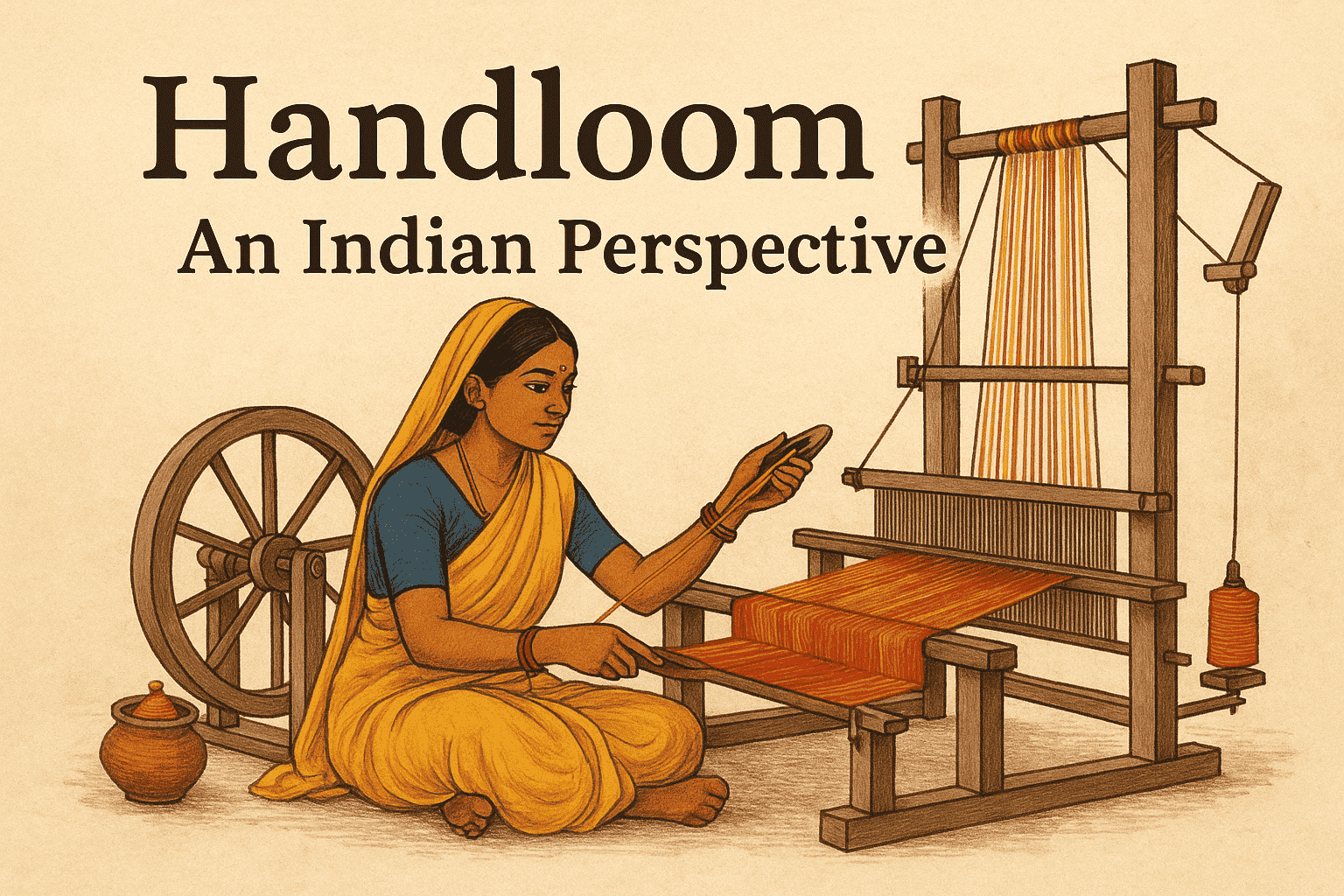
Handloom – An Indian Perspective
India’s handloom heritage is an extraordinary tapestry woven from centuries of tradition, regional diversity, and artistic ingenuity. Each part of the country has developed its own distinctive handloom practices, reflecting local culture, climate, and social customs. Among the most celebrated is Maheshwari weaving from Madhya Pradesh, which stands out for its refined blend of silk and cotton yarns, producing fabrics that are lustrous yet lightweight. The hallmark of Maheshwari textiles is their reversible borders, known as “bugdi,” and motifs inspired by the architecture of Maheshwar, such as chatai (mat), eent (brick), and leheriya (waves). These motifs are intricately woven using dobby and jacquard techniques, and the addition of zari threads lends a regal touch. The process is labor-intensive, often taking several days to complete a single saree, and the resulting fabric is prized for its elegance, durability, and versatility. Maheshwari sarees have become a symbol of sophisticated taste and are cherished both in India and abroad for their unique aesthetic and cultural significance.
Beyond Maheshwari, India’s handloom landscape is marked by a dazzling array of regional weaving traditions, each with its own story and technique. The Kanjeevaram saree from Tamil Nadu is renowned for its thick, lustrous silk and wide borders adorned with temple and peacock motifs, epitomizing South Indian artistry. In Assam, Muga silk is celebrated for its natural golden hue and durability, while Chanderi from Madhya Pradesh is known for its sheer, lightweight texture and delicate zari work. Gujarat and Rajasthan are famous for Bandhani or Bandhej, a tie-dye technique that produces vibrant, dotted patterns, and Patola, a double ikat weave from Gujarat, is revered for its geometric precision and vibrant colors. Odisha’s Sambalpuri sarees showcase intricate ikat patterns and unique tie-dye techniques, while Paithani from Maharashtra dazzles with its tapestry-like motifs and colorful borders. The Baluchari silk saree from Bengal tells stories through its narrative motifs, often depicting scenes from Indian epics, and the Kosa silk of Chhattisgarh is valued for its rich texture and natural shades.
Other notable traditions include the Banarasi silk saree from Uttar Pradesh, famous for its intricate brocades and Mughal-inspired motifs, and the Pochampally Ikat saree from Telangana, which features bold geometric designs created through meticulous tie-and-dye on the yarn before weaving. In Himachal Pradesh, Kullu shawls are cherished for their warmth and bold geometric patterns, while the Patteda Anchu saree of Karnataka, with its reversible pallus and checked patterns, reflects centuries-old weaving traditions. Kerala’s Kasavu saree, with its pristine white fabric and golden borders, symbolizes purity and grace, and Goa’s Kunbi saree showcases simple designs and earthy tones that reflect the rustic charm of the coastal state. Handloom artistry also thrives in the tribal shawls of Nagaland, the Lepcha weaves of Sikkim, the Phanek of Manipur, and the Pachra of Tripura, each bearing the imprint of its community’s heritage and identity.
The beauty and significance of Indian handlooms lie in their diversity and the stories they tell. These textiles are not just garments but cultural artifacts, embodying the skills, values, and histories of the communities that create them. The handloom sector continues to play a vital role in India’s socio-economic fabric, providing livelihoods to millions and promoting sustainable, eco-friendly practices that have a low carbon footprint. In an era dominated by mass production, the enduring appeal of handlooms lies in their authenticity, artistry, and the human touch that makes each piece unique. By supporting and cherishing these age-old crafts, we not only preserve India’s rich heritage but also empower the skilled artisans whose hands keep these traditions alive for future generations.
Related Posts
August 1, 2025
August 1, 2025